

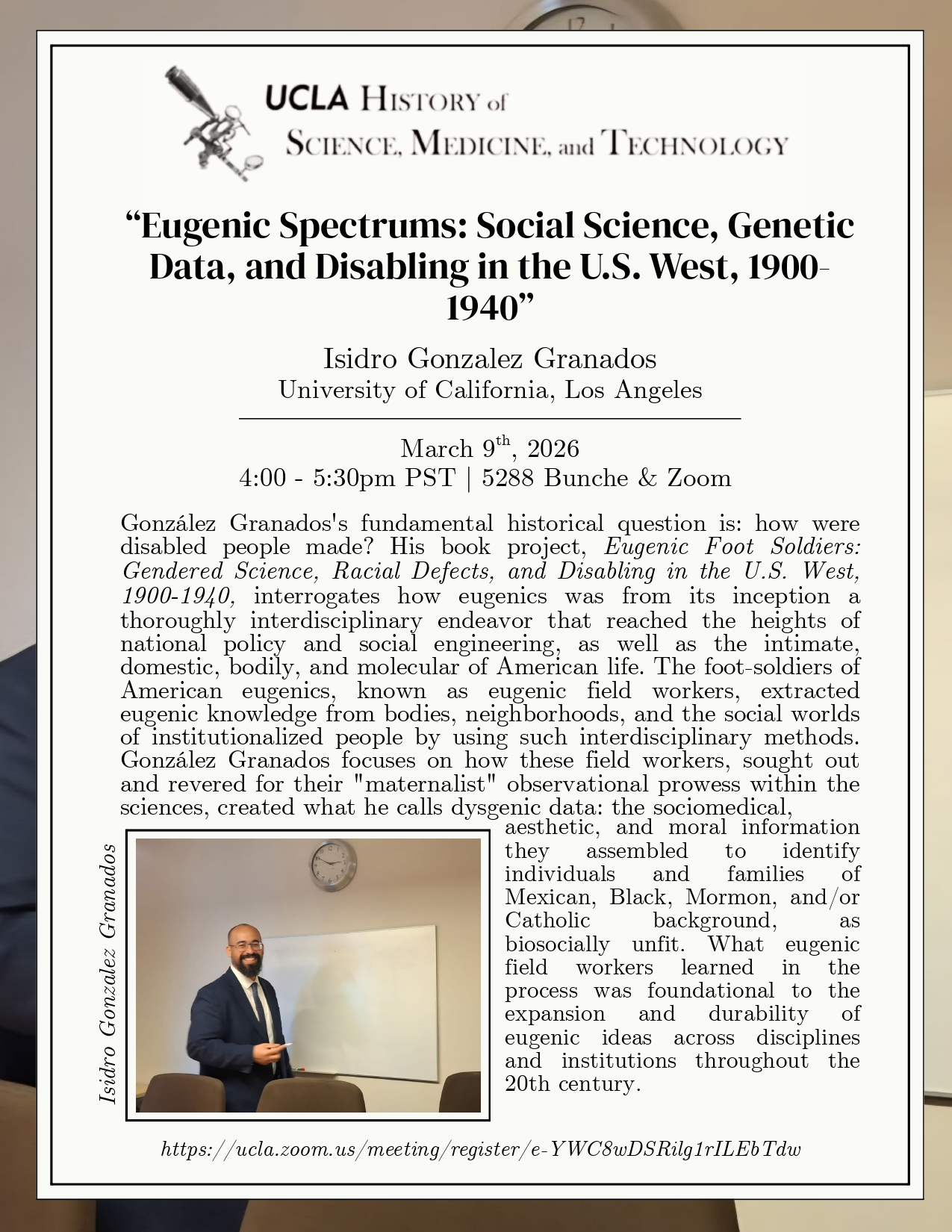
Everyone is welcome to the next installment of the History of Science, Medicine, and Technology Colloquium Series. UCLA Chancellor’s Postdoctoral Fellow, Isidro Gonzalez Granados, will be presenting “Eugenic Spectrums: Social Science, Genetic Data, and Disabling in the U.S. West, 1900-1940.”
González Granados’s fundamental historical question is: how were disabled people made? His book project, Eugenic Foot Soldiers: Gendered Science, Racial Defects, and Disabling in the U.S. West, 1900-1940, interrogates how eugenics was from its inception a thoroughly interdisciplinary endeavor that reached the heights of national policy and social engineering, as well as the intimate, domestic, bodily, and molecular of American life. The foot-soldiers of American eugenics, known as eugenic field workers, extracted eugenic knowledge from bodies, neighborhoods, and the social worlds of institutionalized people by using such interdisciplinary methods. González Granados focuses on how these field workers, sought out and revered for their “maternalist” observational prowess within the sciences, created what he calls dysgenic data: the sociomedical, aesthetic, and moral information they assembled to identify individuals and families of Mexican, Black, Mormon, and/or Catholic background, as biosocially unfit. What eugenic field workers learned in the process was foundational to the expansion and durability of eugenic ideas across disciplines and institutions throughout the 20th century.
See you in the History of Science Room or via Zoom:
https://ucla.zoom.us/meeting/register/e-YWC8wDSRilg1rILEbTdw#/registration.